
In an Interdependent World, War Is an Anachronism
Richard Wilkinson, Roberto De Vogli and Kate Pickett


The conflict between the US, Israel and Iran exposes a truth that modern politics has failed to grasp: in an interdependent world, war has become not only strategically irrational and ecologically suicidal, but morally anachronistic.
Iran’s ability to close the Strait of Hormuz is a stark example. As well as missiles, a country under attack can retaliate by threatening the shared systems on which much of the world, including its opponents, depends. Disrupting the flow of oil, liquefied natural gas and fertilisers raises the costs of energy, food and transport for everyone.
Russia’s invasion of Ukraine tells the same story. As well as disrupting world grain supplies, the war cut Russia off from specialist engines, naval turbines, transit infrastructure and industrial components on which it had long relied. In the modern world, attacking another country increasingly means attacking systems on which we all depend.
War rests on an outdated illusion: that one nation’s security can be built on another’s destruction. In an ecologically and economically interconnected world, however, that is no longer possible. Increasingly, we stand or fall together.
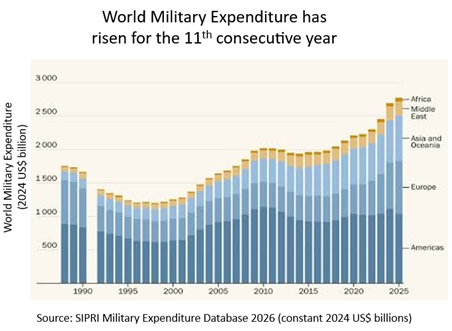
This makes the return of militarism particularly alarming. At precisely the moment when humanity needs unprecedented international cooperation to tackle climate breakdown, the world is sliding deeper into armed rivalry. Global military expenditure reached $2.887 trillion in 2025, the eleventh consecutive year of growth (see figure).
The decade in which the climate emergency has become undeniable has also been a decade of rising military spending. The contradiction could hardly be sharper. Funds urgently needed for renewable energy, flood protection, resilient agriculture, public health, ecological restoration and support for vulnerable countries are instead poured into armaments. Military rivalry also destroys the trust needed for international climate agreements. If, unable to trust others, each country refuses to cut its own emissions, the results would be disastrous.
War is both a human and an environmental catastrophe. The emissions from the war in Gaza alone have been estimated to equal the annual emissions of dozens of small countries. Militarisation consumes vast quantities of fuel, steel, concrete, rare minerals, scientific talent and public wealth. Attention, money and political will are diverted from the environmental crisis that threatens us all.
Nor is actual war the only danger. Political leaders present every increase in weapons stocks and military preparedness as defensive. But to potential adversaries they appear threatening. What one side calls deterrence, the other sees as intimidation. What one side describes as security, the other experiences as menace. Arms races generate the very fears they claim to answer.
Military posturing belongs to a past in which power was imagined primarily as territorial control. It is useless against rising seas, crop failures, droughts, pandemics, collapsing ecosystems and extreme heat. The atmosphere cannot be conquered, oceans cannot be defended by missiles, and no arsenal can prevent ecological collapse.
No nation is now self-sufficient in food, energy, medicines, fertilisers, semiconductors, finance, scientific knowledge or the critical minerals needed for the clean-energy transition. The supply chains that sustain ordinary life run across borders, through allies, rivals and adversaries alike. To damage the world is increasingly to damage oneself.
The same is true of disease. In a world of air travel, trade, urbanisation and ecological disruption, epidemics can cross borders faster than any army can defend them. Protection depends not on military superiority but on trust, transparency, public health capacity, scientific cooperation and mutual support.
The lesson is the same in each case. In an interdependent world, security cannot be achieved against others, only with them.
The realism this century requires is a recognition that security has become indivisible. Rather than a weakness, this is an opportunity. International relations have long been shaped by conquest, imperial competition, armed threat and slaughter. But our global economic and environmental interdependence, existing alongside the destructive power of modern weaponry, now challenges us to create a better world order.
Security should no longer mean the ability to threaten others. It must mean the capacity to sustain the shared systems on which all depend. A serious security policy would measure safety not by the size of arsenals but by the strength of the systems that protect life: climate stability, food and water security, public health, disaster preparedness, ecological restoration, diplomacy, scientific exchange and international institutions capable of preventing conflicts before they begin. These are not soft alternatives to security. They are what security now means.
And something else has changed. In ordinary life, violence has steadily lost much of the legitimacy it once possessed. We expect disputes between individuals and groups to be settled through law, negotiation, mediation and democratic institutions, not by force. Practices once accepted as ordinary expressions of power – from duelling and public execution to corporal punishment and domestic violence – have increasingly become morally intolerable. Yet between states we continue to suspend these standards.
War survives as an enclave of officially sanctioned violence in societies that otherwise pride themselves on having renounced it. Acts that would be called murder, terror and devastation if committed at home are relabelled as strategy, deterrence or collateral damage when ordered by governments. Political leaders who would be appalled by a single killing in their own streets can authorise attacks in which thousands of distant strangers are burned, crushed, mutilated, orphaned or driven from their homes.
Our largely protected lives should make the realities of war more unacceptable than they seemed to previous generations. But rather than being evidence that we have become excessively sensitive, it reflects a moral advance central to progress. We have come to recognise more fully the value of individual lives, the suffering inflicted by violence and the rights of people previously regarded merely as subjects, enemies or expendable populations.
Why then have the moral standards governing ordinary human relationships not been extended to relations between nations? Why should conduct that would horrify us within our own society become acceptable merely because it crosses a border or is authorised by a state? We have civilised relations within nations while leaving relations between nations dangerously uncivilised. War is the last great refuge of forms of violence we have learned to condemn almost everywhere else.
To recognise war as an anachronism is not to deny societies the right to defend themselves against aggression. It is to recognise that even defensive war is a catastrophe forced upon them by the failure of the international order – not a normal, legitimate or acceptable way of conducting international relations. The aim must be to build institutions strong enough to prevent aggression, resolve disputes and protect threatened populations before organised slaughter becomes the only remaining response.
A politics that talks lightly of bombing, obliteration and overwhelming force is therefore not merely callous. It is unfit for an age of planetary emergency, interdependence and growing moral revulsion against violence. Humanity needs a historic shift in the spirit of international relations: from rivalry to cooperation, from domination to reciprocity, and from preparation for war to preparation for survival.
The environmental movement should say without equivocation that the wealth now poured into arms, deterrence and military rivalry must be redirected towards ecological repair, mutual support, trust-building and shared security. Our task is to turn foes into partners and rebuild international relations not around the means of destruction, but around the means of life.
It is time we recognised war as one of the great anachronisms of our age. If it belonged anywhere, it was to a world of conquest, empire and domination – not to a world of ecological limits, shared vulnerability, moral equality and deep material interdependence.
What once passed for realism has become suicidal irrationality. To make peace with our planet, we must make peace with each other.
 | A guest post by
|